DIY Pool Closing Guide | Boldt Pools & Spas
Advice - Pools
Wondering how to close a pool in Ontario before winter? Start by choosing the right closing window, cleaning and balancing the water, protecting the plumbing and equipment from freezing, and securing a winter cover that suits your pool. The exact procedure changes for inground, fibreglass, vinyl liner, onground and above-ground pools. This guide helps you plan the work, spot the risky steps and decide when to call a professional.
Quick answer: When should I close my pool in Ontario? Most Southern Ontario owners plan their closing in September or October, although the right date depends on the weather, water temperature and local conditions. Avoid closing so early that warm water encourages algae; just as importantly, finish winterization before freezing weather puts exposed plumbing or equipment at risk. Book service early if you need help.
Jump to: Timing · What a closing includes · Checklist · Water chemistry · Inground and fibreglass · Above-ground and onground · Equipment · Winter covers · DIY or professional · FAQs
Important: Pool closing is not one-size-fits-all. Follow the written instructions for your exact pool structure, liner or shell, cover, pump, filter, heater and sanitizer. Do not use generic chemical doses or water-lowering depths. Municipal requirements and water-discharge rules may also vary by location. If you cannot positively identify a line, valve or shutdown step, stop and ask a qualified pool technician.
When to close a pool in Niagara and Southern Ontario
When deciding how to close a pool in Ontario, begin with timing. For many owners in Niagara and surrounding communities, September to October is a practical planning window. Weather matters more than any fixed calendar date: warm water can support algae, but a sudden cold snap can damage plumbing and heaters that still contain water. If your equipment sits outdoors, watch the forecast closely and leave time to finish the work before a freeze.
A simple planning sequence works well:
- One to two weeks before closing: Identify your pool type, find equipment manuals, inspect the winter cover and arrange water testing or service.
- Several days beforehand: Remove leaves and debris, clean the pool and correct water balance based on your test results and product directions.
- Closing day: Complete your pool-specific water-level and plumbing plan, protect equipment and fit the winter cover correctly.
- Throughout winter: Check the cover, water level, sump well (if fitted) and surrounding drainage safely after major weather events.
Do not wait for the first hard freeze to discover a stuck valve, missing winter plug or torn cover. On the other hand, closing much too early while water remains warm may increase the chance of algae growth before spring.
What does a pool closing include, and what does it not include?
A complete winterization plan addresses water chemistry, cleaning, the pool structure, plumbing, equipment, fittings and the winter cover. It also identifies the components that need indoor storage or manufacturer-specific care.
Before booking, review what the Boldt Pools & Spas pool closing service covers. Our team outlines the preparation tasks customers should complete before their appointment.
Additional services and charges: Routine vacuuming and chemical balancing are customer preparation tasks rather than standard closing inclusions. Winterizing chemical kits are available as optional purchases. Solar-system winterization may require separate arrangements and additional charges. Confirm pricing with your local Boldt service team.
Services we do not offer: Boldt Pools & Spas does not remove drop-in steps or sandbags. Customers must arrange their removal before the closing appointment. Salt-cell and cartridge-filter cleaning arrangements can vary by service package, so confirm whether these tasks are included in your booking.
Additionally, water-lowering requirements may vary by municipality, as well as by pool structure, cover and equipment. Some locations or booking types require customers to lower the water before the appointment. Confirm the applicable municipal requirements, service instructions, pricing and availability with your local team.
What a closing cannot guarantee: A winter cover cannot correct leaking plumbing, poor drainage, damaged equipment or unbalanced water by itself. Winterization reduces risk, but severe weather and changing site conditions still require periodic checks.
Pool winterizing supply and equipment checklist
Gather everything before shutting down circulation. Your exact list depends on the pool and the parts you own.
- Cleaning and testing: Leaf net, vacuum or robotic cleaner, pool brush, water-test kit or a professional water test, and suitable filter-cleaning supplies.
- Water care: Only the balance products and winterizing chemicals your test results and manufacturers call for. Shop pool closing chemicals after confirming what you actually need.
- Plumbing and equipment: Correctly sized winter plugs or caps, skimmer protection where applicable, labelled storage bags, and the manuals for your pump, filter, heater and sanitizer. A suitable line-clearing setup requires training and the correct equipment.
- Winter cover: A compatible cover, intact straps or fasteners, the right anchors or water bags, and any manufacturer-approved accessories. Browse pool closing accessories.
- Safety: Protective gloves and eyewear when handling chemicals, a safe electrical disconnect, and a plan for local water-discharge rules. Never mix chemicals or add them in a way that conflicts with the label.
Before you buy: Match each plug and cover accessory to your pool's fittings and installation. Keep a photo of the equipment pad and a list of model numbers for future service calls.
Water chemistry and cleaning before winterizing
The best spring openings usually begin with a clean pool in the fall. Skim leaves, vacuum the floor, brush the walls and waterline, and empty accessible baskets. Address visible algae or cloudy water before closing instead of expecting winter chemicals to solve an existing problem.
Next, test the water. Check sanitizer, pH, total alkalinity and calcium hardness as appropriate for your pool; a salt system or other specialized equipment may require additional checks. Follow your pool manufacturer's acceptable ranges and the directions on each product. If the water needs treatment, allow the required circulation and contact time while the system can still operate safely.
Do not copy a fixed dose from another pool's checklist. Pool volume, sanitizer type, concentration, current chemistry and surface materials all affect treatment. For help, visit a Boldt Pools & Spas location for water-testing assistance or browse water testing products.
Avoid this mistake: Adding closing chemicals after the pump has stopped can prevent proper distribution. Read product directions and complete any circulation-dependent treatment before you shut the system down.
How to close an inground, fibreglass or vinyl liner pool
Inground pools often use permanent underground suction and return lines, skimmers, heaters and more complex equipment. For these pools, the most important winterizing step is to protect each water-carrying component from freezing without damaging the shell or liner.
Inground pool closing: the safe sequence
- Document the system. Photograph the valves, equipment connections and cover hardware; locate the manuals and identify every skimmer, return, cleaner line, water feature and other branch.
- Clean and balance. Remove debris, brush and vacuum, and test the water before making final chemical adjustments.
- Confirm the water-level plan. The correct level depends on the structure, cover, skimmers, returns, groundwater conditions, manufacturer guidance and applicable municipal requirements. Check municipal rules and your closing-service instructions before lowering or discharging water. Never use an all-purpose depth from an unrelated guide.
- Winterize the plumbing. A trained person must clear and isolate vulnerable lines with equipment and methods suited to the system. Incorrect air pressure, missed branches and inadequate plugging can cause serious damage.
- Shut down and drain equipment. Follow the pump, filter, heater and sanitizer manuals; isolate electrical or gas equipment only as their instructions and applicable regulations allow.
- Secure the cover. Use its specific installation and tension instructions; confirm that fittings, anchors and fabric are sound.
- Record your work. Note the date, final readings, closed valves, stored parts, and any repair the pool will need in spring.
Fibreglass pools: Water provides structural support, and groundwater can create pressure around the shell. Never fully drain or significantly lower a fibreglass pool on generic advice. Follow the shell manufacturer's guidance and consult a professional when groundwater, drainage or the water-level requirement is uncertain. Confirm any applicable municipal requirements before changing or discharging the water level.
Vinyl liner pools: Protect the liner by maintaining the water level required for the structure and cover. Excessive water removal can allow a liner to shift, wrinkle or lose support. Handle ladders, steps and fittings carefully to avoid tearing the liner.
Concrete or other inground pools: Finish materials, tile, waterlines and winter cover systems may have different requirements. Use your builder's closing instructions rather than applying fibreglass or vinyl liner rules unchanged.
How do above-ground and onground pool closings differ?
Above-ground pools may have flexible hoses, exposed skimmers, wall returns, seasonal equipment and cover cables rather than the buried plumbing of an inground pool. Disconnecting, draining or storing components must still follow the pool and equipment manufacturer's directions. Do not assume an above-ground pool should be emptied: the water often helps support its walls and liner.
Onground pools sit partly in or against the surrounding grade and may combine accessible equipment with buried pipes or substantial decking. Their winterizing plan depends on how the builder installed the plumbing, wall supports and cover. Treat them as their own configuration—not automatically as an above-ground or inground pool.
| Pool type | Pay particular attention to | Do not assume |
|---|---|---|
| Inground vinyl liner | Buried lines, liner support, skimmers and cover anchors | Every vinyl pool needs the same water level |
| Fibreglass inground | Shell support, groundwater, approved lowering limits | It is safe to drain the shell significantly |
| Onground | Mixed exposed/buried lines, deck access and wall conditions | An above-ground checklist covers every connection |
| Above ground | Wall and liner support, hoses, skimmer/return fittings and cover tension | You can empty the pool or leave fittings exposed |
If you have a manufacturer's manual for your exact above-ground pool, use it. Some manufacturers explicitly warn against lowering water after it has frozen because the ice can damage the structure. The Boldt resource library and relevant product pages can help you locate instructions.
Protecting plumbing, pumps, filters and heaters
You can close a pool with clear-looking water and still face expensive repairs if moisture freezes inside a vulnerable component. Use this equipment glossary to check that your closing plan covers each part.
| Component | Its job | Winterizing question to resolve |
|---|---|---|
| Skimmer | Draws surface water toward the pump | Which approved skimmer protection and plugs fit this model? |
| Suction and return lines | Carry water between pool and equipment | Has a trained person confirmed every branch is protected? |
| Pump | Circulates pool water | Which drain points and power shutdown steps does its manual specify? |
| Sand, cartridge or D.E. filter | Removes debris from circulating water | How should this filter drain, clean and sit over winter? |
| Heater or heat pump | Heats the water | Which shutdown, drain and freeze-protection procedure applies to the model? |
| Salt cell or chlorinator | Helps sanitize the water | Must the cell or vessel be cleaned, drained or stored indoors? |
| Water feature or solar system | Adds circulation through extra piping | Does it need a separate winterization appointment or specialist? |
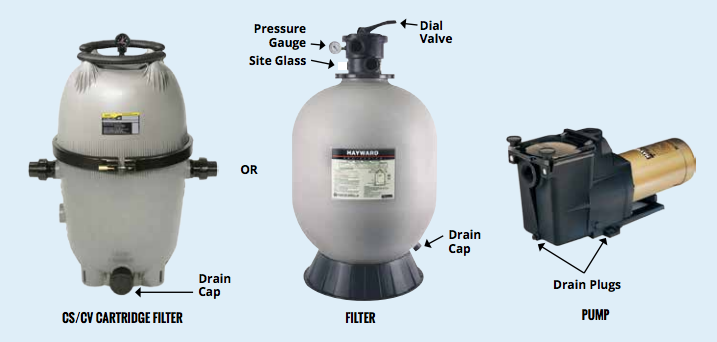
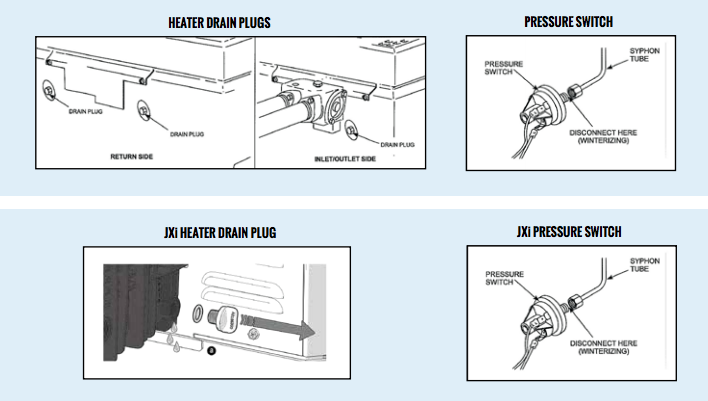
Do not experiment with compressed air or gas connections. Pressurizing the wrong line or trapping pressure can injure people and damage plumbing. Gas-fired heaters and electrical equipment require the correct shutdown procedures, and some steps call for licensed professionals. Refer to manufacturer manuals or request equipment service.
Also check any sump well used around the pool structure. Boldt asks closing customers to pump down their sump well approximately 48 hours before service. Significant standing water may prevent a safe closing, and the site may require continued drainage checks throughout winter.
Reminder sign-up form coming soon.
Choosing winter covers, safety covers and snow protection
A winter cover helps keep debris out, limit light and protect your pool through the off-season, but not every winter cover is a safety cover. Choose the cover that fits your pool type, coping, surroundings and manufacturer's specifications.
| Cover type | Typical purpose | Important consideration |
|---|---|---|
| Anchored safety cover | Secures across compatible pools using rated straps and anchors | Check certification, installation, fit, anchor condition and permitted snow loads; keep safety barriers in place |
| Lock-in vinyl cover | Fits a compatible track around the pool edge | Inspect the track, seating and any step-cover requirements |
| Standard winter tarp or Fabrene-style cover | Helps block debris and light | Use compatible water bags, cable or other approved restraints; it is not a safety cover |
| Above-ground winter cover | Fits the pool's wall and rail configuration | Follow the pool and cover manuals for tension, support and winter checks |
Explore Boldt safety covers or winter cover options to compare materials and fittings. Never treat a cover as a replacement for fencing, locked access or supervision. Keep children and pets away from the closed pool and do not walk on a cover unless its specific certified use and instructions expressly allow it.
After heavy wind, rainfall, ice or snowfall, look for displaced straps, sagging, damaged anchors and drainage problems from a safe location. Do not climb onto a cover or stand on unsafe ice. For a mesh safety cover, some rainwater and fine debris may enter the pool; plan spring water treatment accordingly.
DIY closing vs professional pool closing in Ontario
Before deciding how to close a pool in Ontario, compare the risks of the jobs you can perform safely with those that need specialist tools. DIY preparation makes sense when you understand your equipment, have compatible supplies and can follow the relevant manuals. However, winterizing multiple buried lines, a heater, an unfamiliar salt system, a fibreglass shell or a complex water feature can justify professional help.
Choose professional help if you cannot map the plumbing; suspect a leak; have missing or damaged plugs; need to winterize a heater or special feature; cannot confirm the correct water level; or lack the right tools and training. Protecting the pool now can cost much less than repairing freeze damage in spring.
Before booking, ask what is included, which tasks carry additional charges, what preparation you must complete and which services are unavailable. Also confirm the correct water level for your pool and municipality. Water-discharge regulations and service requirements can differ between Ontario municipalities, so follow local requirements alongside your pool and cover manuals.
Ask about Boldt pool closing service where available, or shop winterizing products if you plan to handle the approved steps yourself.
Common pool closing mistakes—and what they can mean in spring
- Closing too early or closing dirty water: Increased chance of algae, stains and a harder spring opening.
- Guessing at chemical doses: Unbalanced water, staining or possible surface/equipment damage.
- Lowering too much water: Risk to a fibreglass shell, vinyl liner or pool wall support.
- Missing a line or drain point: Freeze damage and leaks when you restart the system.
- Ignoring a salt cell, heater or water feature: Leftover water may damage specialized components.
- Choosing the wrong cover or poor tension: Torn material, lost anchors, accumulated debris or unsafe conditions.
- Ignoring the sump well and local drainage: Water buildup around the structure or problems with municipal compliance.
Pool closing checklist: save this for fall
Before closing: Confirm pool type and manuals; choose the closing date; book help if needed; inspect your winter cover; identify valves, water features and equipment; check discharge rules; remove debris; test and balance water.
On closing day: Verify the water level using your pool instructions, applicable municipal requirements and closing-service directions. Confirm plumbing isolation and winterization; drain and secure equipment according to manuals; check skimmer protection; remove and store accessories as needed; fit the cover; photograph final settings.
During winter: Look for cover damage after storms; check appropriate water levels and sump drainage; keep access barriers secured; contact a professional if you suspect a leak, structural movement or unsafe ice.
Keep your closing plan handy. Download and print the one-page checklist, with steps for before closing, closing day and winter check-ins.
Printable Pool Closing Checklist
Frequently asked questions about Ontario pool closing
How do I winterize an inground pool in Ontario?
Start with cleaning and water testing, then follow your inground pool's approved water-level, plumbing, equipment and cover instructions. Protecting buried pipes and equipment against freezing is essential. Check applicable municipal requirements, and if you cannot identify every line, ask a professional to complete the winterization.
How do I close an above-ground pool for winter?
Clean and balance the water, follow the above-ground pool manufacturer's guidance for water level and fittings, protect or store the exposed equipment, and secure a compatible winter cover. Do not empty the pool or disconnect parts based on a generic guide.
How do I winterize an onground or fibreglass pool?
An onground closing must account for its unique mix of exposed and buried plumbing. Fibreglass pools require extra care with water levels and groundwater pressure. Consult the pool builder's or shell manufacturer's instructions before lowering any water.
What should I do about my pool's water chemistry before closing?
Test sanitizer, pH, alkalinity and other parameters that apply to your pool. Use the test results and label directions to correct any imbalance while the system can circulate. Avoid copying chemical quantities from a different pool size or product.
Is a pool safety cover the same as a regular winter cover?
No. A properly specified and installed safety cover offers a different protective function than an ordinary winter tarp. Check the cover's certification and manufacturer instructions, and maintain pool fencing and access controls in every season.
Does professional pool closing include cleaning and chemicals?
Routine vacuuming and water balancing are not part of the standard closing. Winterizing chemical kits are available as add-on purchases, and specialty systems such as solar heating may need separate service. Boldt does not remove drop-in steps or sandbags. Confirm the tasks, pricing and requirements of your booking.
What happens if I skip winterizing my pool plumbing?
Water can freeze and expand inside lines, heaters and equipment, damaging fittings and causing leaks. A complete, model-specific winterization plan reduces that risk.
Can I book an Ontario pool closing service late in the season?
Availability varies by location and weather. Contact your local provider as early as possible; never assume an appointment will be available before a sudden freeze.
Rather Leave Pool Closing to the Experts?
Closing your pool requires careful preparation, from protecting pipes and equipment to fitting a winter cover correctly. If you'd prefer some help, Boldt Pools & Spas is here for you.
Leave the technical work to our experienced service team. We'll help you understand what your closing includes and what to prepare before your appointment, so you can head into winter with greater peace of mind.
Book Your Professional Pool Closing